2025 年 12 月 12 日,位於美國華盛頓特區的美國貨幣監理署(Office of the Comptroller of the Currency,OCC)發布公告,有條件批准 Ripple、Circle、Paxos、BitGo 以及 Fidelity Digital Assets 五家數位資產機構,轉型為聯邦特許的國家信託銀行。
這一決定並未伴隨劇烈的市場波動,卻被監管與金融圈普遍視為一個分水嶺。長期遊走在傳統金融體系邊緣、頻繁遭遇銀行服務中斷的加密企業,第一次以「銀行」的身份,被正式納入美國聯邦銀行監管框架。
變化來得並不突然,卻足夠徹底。Ripple 計劃設立「Ripple National Trust Bank」,Circle 將運營「First National Digital Currency Bank」。這些名稱本身,已經清晰傳達出監管層釋放的信號:數位資產相關業務不再只是被動接受審查的「高風險例外」,而是被允許在明確規則下,進入聯邦金融體系的核心層。
這一轉向,與幾年前的監管環境形成鮮明對比。尤其是在 2023 年銀行業動蕩期間,加密行業一度深陷所謂「去銀行化」困境,被系統性切斷與美元結算體系的聯繫。而隨著 2025 年 7 月特朗普總統簽署《GENIUS 法案》,穩定幣與相關機構首次獲得清晰的聯邦法律定位,也為 OCC 此次集中發牌提供了制度前提。
本文將圍繞「什麼是聯邦信託銀行」「這張牌照為何重要」「特朗普時代的監管轉向」以及「傳統金融的應對與挑戰」四個層面,梳理這次批准背後的制度邏輯與現實影響。核心判斷是:加密行業正在從依賴銀行體系的「外部使用者」,轉向成為金融基礎設施的一部分。這不僅改變了支付與清算的成本結構,也正在重塑「銀行」在數位經濟中的定義。
To truly understand the significance of this OCC approval, we first need to clarify a commonly misunderstood point: this is not five crypto companies receiving a traditional "banking license."
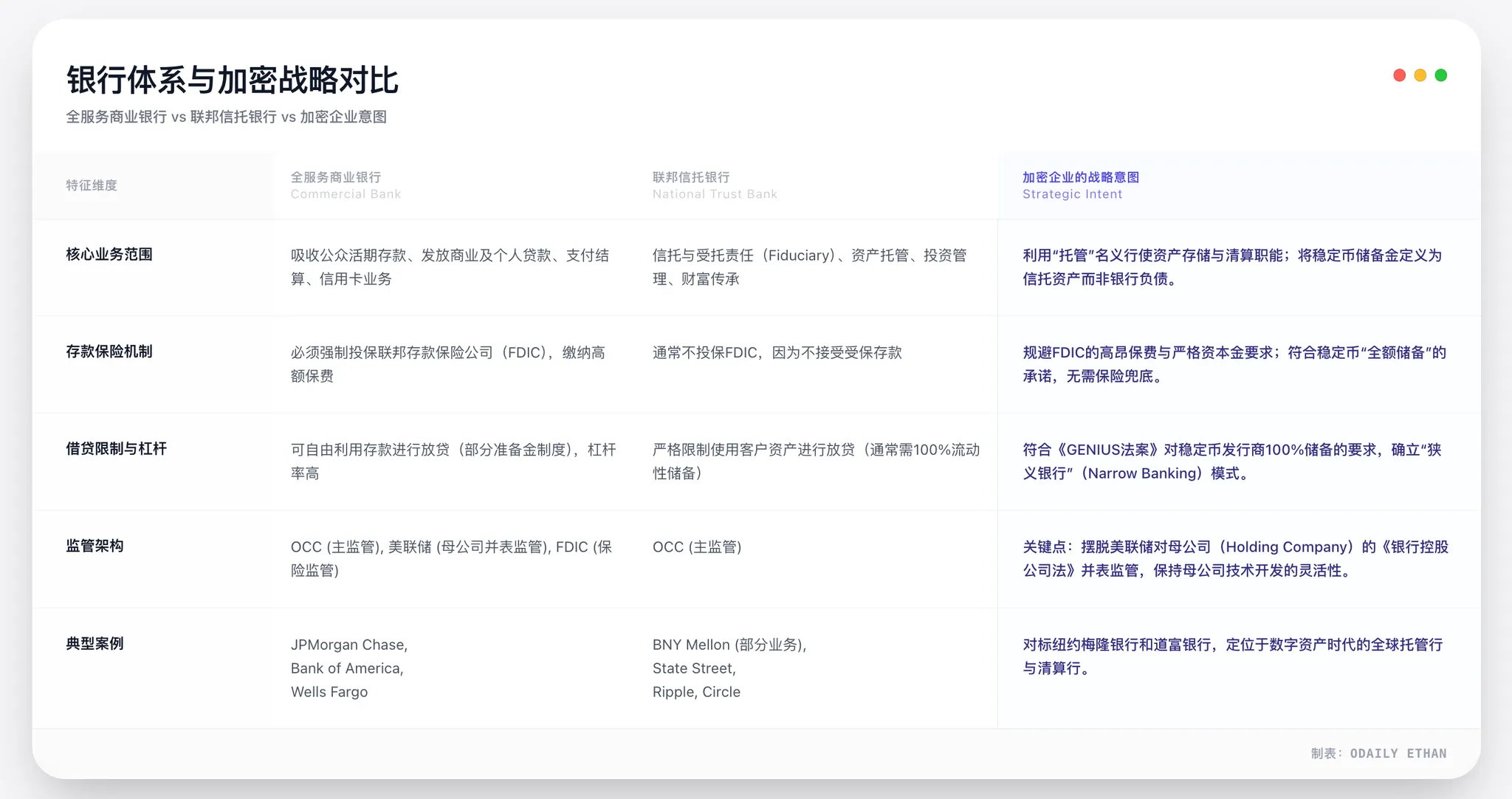
What the OCC approved is a "National Trust Bank" charter. This is a type of bank charter that has long existed in the U.S. banking system but has historically been used for businesses such as wealth management and institutional custody. Its core value lies not in how much business it can conduct, but in its regulatory oversight and infrastructure status.
Within the U.S.'s dual-track banking system, financial institutions can choose to be regulated by state governments or the federal government. The compliance requirements of the two are not merely parallel but exhibit a clear hierarchical power difference. A federal charter bank license issued by the Office of the Comptroller of the Currency (OCC) means that the institution is directly regulated by the Treasury Department system and enjoys "federal preemption," meaning that it no longer needs to individually adapt to each state's regulatory rules in terms of compliance and operations.
The legal foundation behind this can be traced back to the 1864 National Bank Act. Over the next century and a half, this system became a key institutional tool for the U.S. in developing a unified financial market. This is particularly crucial for crypto companies.
Prior to this approval, whether it was Circle, Ripple, or Paxos, to operate compliantly nationwide in the U.S., they had to apply for Money Transmitter Licenses (MTL) in all 50 states, facing a patchwork system of regulatory approaches, compliance requirements, and enforcement standards that were entirely different. This was not only costly but also severely limited business expansion efficiency.
By converting to a federal trust bank, the regulatory oversight shift goes from various state financial regulatory agencies to a unified oversight by the OCC. For enterprises, this means a unified compliance path, a national business license, and a structural elevation of regulatory credibility.
It is essential to emphasize that a federal trust bank is not equivalent to a "full-service commercial bank." The five institutions approved this time are not allowed to take FDIC-insured public deposits or issue commercial loans. This is also a core reason for skepticism raised by traditional banking organizations (such as the Bank Policy Institute) regarding this policy, as they see it as an "unequal rights and obligations" entry.
However, from the perspective of the crypto companies' own business structures, this restriction is highly fitting. Taking stablecoin issuers as an example, whether it is Circle's USDC or Ripple's RLUSD, their business